- $0what using a broker adds to your premium
- 76%of active HealthCare.gov plan selections for 2026 had help from an agent or broker
- 23.1Mpeople picked a marketplace plan for 2026, all at the same filed prices
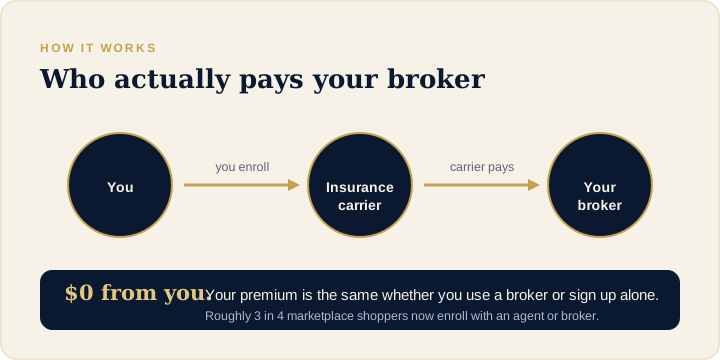
How brokers actually get paid
Insurance carriers build a small commission into every plan and pay it to the licensed broker who helps you enroll. That cost is already baked into the premium whether you use a broker or not. So if you sign up alone, the carrier simply keeps that amount. You don't save anything by skipping the broker. Use a broker and you get the same plan, the same price, plus a licensed advocate for the life of the policy.
You do not have to take my word for it. HealthCare.gov's own glossary describes agents and brokers as trained, state licensed professionals, says they are paid commissions by insurance companies, and says enrolling with one costs you nothing extra. It also notes you still get every premium tax credit you qualify for, as long as the broker enrolls you through the Marketplace.
Is the price different if I go direct?
No. By law and by carrier rules, the premium for a given plan is the same price whether you buy it directly, through Healthcare.gov, or through a broker. A broker cannot mark it up, and going direct does not discount it. According to CMS, 23.1 million people picked a marketplace plan during open enrollment for 2026, and every one of them pays the same filed rate for their plan whether or not a broker helped them.
Most marketplace shoppers now use a broker
Using a broker is not the unusual choice anymore. It is the normal one. CMS reports that 76 percent of the 10.8 million people who actively picked a HealthCare.gov plan for 2026 had help from an agent or broker. That share is 22 percentage points higher than it was in 2021.
The reason is not hard to see. The marketplace got more complicated, not less, and a free expert is an easy call when the alternative is a long hold queue.
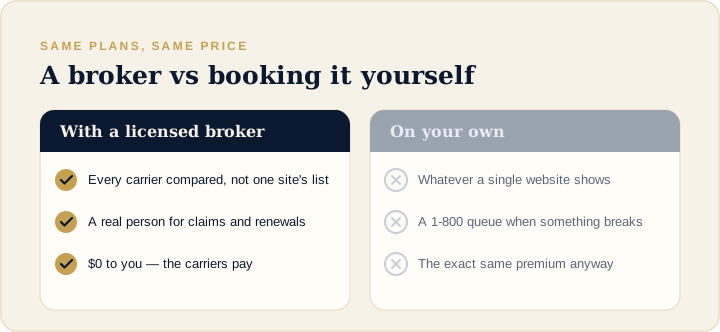
What does a broker do that a website doesn't?
A website shows you plans. A broker tells you which one is right for your doctors, prescriptions, and budget, and then stays on call when a claim is denied, a bill looks wrong, or it's time to renew. You get a direct line instead of a 1-800 hold queue. In practice, that means I:
- Get your income estimate right, because that single number sets your premium tax credit, and a bad estimate can mean a bill at tax time.
- Check your doctors and prescriptions against each plan's network and drug list before you enroll, not after.
- Compare the real monthly cost after your subsidy is applied, across every carrier I am appointed with in your area.
- Handle renewals and life changes, like a new baby, a move, or a raise that changes what you qualify for.
- Help when something goes wrong, from a denied claim to a billing mix up.
The subsidy piece alone is worth real money. CMS reports the average marketplace premium for 2026 was $619 a month before premium tax credits and $178 a month after them. On HealthCare.gov, 29 percent of people picked a plan with a $0 monthly premium after their credit. You can run a rough estimate with my subsidy calculator before we ever talk.
Why this matters more than usual right now
The enhanced premium tax credits expired at the end of 2025, and KFF found that premium payments after tax credits rose 58 percent on average for people who signed up for 2026 coverage. Then for 2027, Cigna is leaving the ACA individual market in all 11 states where it sells, and about 369,000 people will need a new plan. If you get a non renewal letter this fall, here is what it means and what to do.
Open enrollment for 2027 coverage runs on these dates on HealthCare.gov. States that run their own exchanges can set different deadlines.
- November 1, 2026Open enrollment begins for 2027 coverage
- December 15, 2026Last day to choose a plan that starts January 1, 2027
- January 15, 2027Open enrollment closes on HealthCare.gov
Are brokers unbiased?
An independent broker isn't tied to a single company, so the goal is finding what genuinely fits you rather than selling one carrier's product. That independence is the whole point. HealthCare.gov draws the same line: agents may work for a single company, while brokers may represent several. Ask anyone you are considering which one they are, and ask them to show you the comparison rather than describe it.
Red flags to watch for
- Any fee to enroll you in a marketplace plan. The carrier pays the broker. You should not.
- Changing your plan without talking to you. CMS added system safeguards before the 2025 open enrollment after a rise in complaints about unauthorized plan changes. A good broker never touches your coverage without your say so.
- A license number they won't share. Every agent in the country can be looked up through the NAIC lookup. Mine is on my license page.
- Pressure to decide today. Outside of a real deadline, a good plan will still be a good plan tomorrow.
Bottom line
Same plans, same prices, zero broker fees, with someone in your corner. I'm Carson Hornish, licensed in every state (NPN 21581721). If you are self employed, start with my self employed guide. If you are in Florida, here is how to choose a Florida broker.
Common questions
Do you pay a health insurance broker?
No. Independent health insurance brokers are free to the client. They are paid a commission by the insurance carriers, which is already built into the plan premium whether or not you use a broker. HealthCare.gov itself says enrolling with an agent or broker costs you nothing extra.
Is a health plan cheaper if I buy it directly instead of through a broker?
No. The premium for a given plan is the same price whether you buy it directly, through Healthcare.gov, or through a broker. Brokers cannot mark up the price, and buying direct does not discount it. You also keep every premium tax credit you qualify for when a broker enrolls you through the Marketplace.
What does a health insurance broker do?
An independent broker compares the plans you qualify for across many carriers, explains the trade-offs, checks subsidy eligibility, enrolls you, and provides ongoing support for claims, billing questions, and renewals, at no cost to you. A good broker also checks your doctors and prescriptions against each plan before you enroll.
How many people use a broker for marketplace health insurance?
Most of them. CMS reports that 76 percent of the 10.8 million people who actively picked a HealthCare.gov plan for 2026 had help from an agent or broker. That share is 22 percentage points higher than in 2021.
How do I check that a health insurance broker is licensed?
Ask for their National Producer Number and state license number, then look them up yourself. Any agent in the country can be verified through the NAIC lookup, and each state insurance department runs its own search. A broker who hesitates to share those numbers is a broker to skip.
Ready for a straight answer?
Get a free quote and I'll compare the plans you qualify for, no cost, no pressure, today or ever.
Get a free quote →Sources
- HealthCare.gov, Agent and broker (health insurance) glossary
- CMS, Exchange coverage remains near record high as 23.1 million enroll for 2026
- CMS, Health Insurance Exchanges 2026 Open Enrollment Report
- KFF, How has ACA marketplace enrollment changed across states in 2026
- STAT, Cigna to exit the ACA individual market in 2027
- CMS enrollment deadlines for 2027 coverage, via healthinsurance.org