- 9.5MAmericans were self employed in an unincorporated business in August 2026
- 87%of people who picked a marketplace plan for 2026 chose one with a premium tax credit
- $0what my help costs you. Brokers are paid by the carriers
You are far from the only one buying your own coverage
About 9.5 million Americans were self employed in an unincorporated business in August 2026, according to Bureau of Labor Statistics data. That count does not include the millions more who run an incorporated business or pick up 1099 work on the side. Every one of them has to solve health insurance without an HR department, and most of them land in the same place: the individual market, where 23.1 million people picked a plan during open enrollment for 2026.
The first thing I tell every self employed client is simple. Your health insurance is a business decision, and it deserves the same attention you give your rates and your taxes.
Where self-employed people actually get coverage
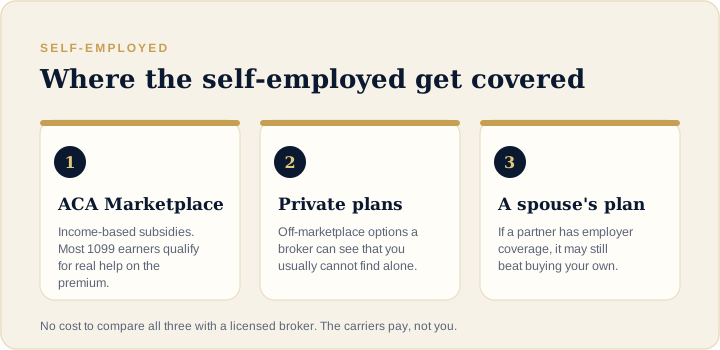
The two main paths are the Affordable Care Act (ACA) Marketplace (Healthcare.gov plans, where you may qualify for subsidies that lower your premium based on your income) and private health plans sold off-marketplace that many people never see on their own. Which one wins depends on your income, your doctors, your prescriptions, and how you use care. There's no single "best" plan. There's a best plan for you.
If you are married and your spouse can join a subsidized employer plan, that is a third path worth pricing. It also changes your tax picture, which I cover below. Because self-employed income can swing from year to year, getting your estimate right matters, and the subsidy rules are shifting for 2027, which I explain in my 2027 subsidy cliff guide.
Do self-employed people qualify for subsidies?
Often, yes. ACA premium tax credits are based on your estimated household income for the year, not on having an employer. Nationally, 87 percent of people who picked a marketplace plan for 2026 chose one with a premium tax credit. According to CMS, the average marketplace premium was $619 a month before that credit and $178 a month after it. Many self employed people are surprised how far their premium drops once eligibility is checked correctly. You can estimate what you would pay with my subsidy calculator before you shop.
What changed for 2026, and why your bill may have jumped
The enhanced premium tax credits that had been in place since 2021 expired at the end of 2025. KFF found that premium payments after tax credits rose 58 percent on average for people who signed up for 2026 coverage. If your bill went up in January and nobody has looked at your plan since, that is the reason.
It is also the best argument I know for shopping every single year. A plan that was the right answer for you in 2024 is often not the right answer now, and letting it renew on autopilot is how people end up overpaying.
How to estimate 1099 income without getting burned
The subsidy you receive during the year is an advance based on your own estimate. When you file your taxes, the IRS compares it to what you actually earned. Estimate too low and you may have to pay back the extra credit you received. Estimate too high and you overpay every month, though you get the difference back when you file. Here is how I walk clients through it.
- Start from net profit, not gross receipts. Your business expenses come off first. Last year's Schedule C is usually the best starting point.
- Adjust for what you actually expect this year. A big new client, a slow season, or a planned break all count.
- Update the marketplace when your income changes. It takes a few minutes and it resets your credit for the rest of the year.
- Loop in your tax preparer. Retirement contributions and the health insurance deduction can both affect the number, and that is their specialty.
Can I deduct my premiums?
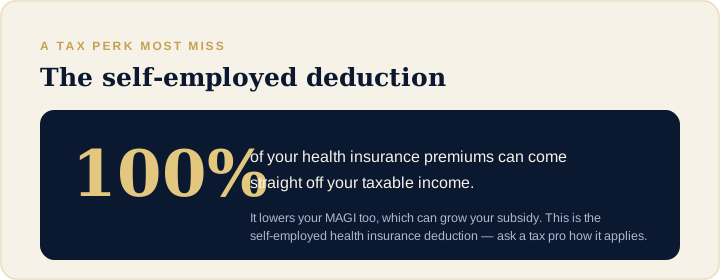
Usually, yes. The IRS lets self employed people deduct health insurance premiums for themselves, a spouse, dependents, and even a child who was under 27 at the end of the year, using Form 7206. Two limits matter. The deduction cannot be more than the net profit of the business the plan is established under. And you cannot take it for any month you were eligible to join a subsidized employer plan, including a spouse's, even if you did not actually enroll. This is a tax question, so confirm the specifics with your tax professional, but it's worth knowing before you choose a plan.
Sole proprietor, LLC, S corp, or 1099 contractor: does your structure change your options?
This is one of the most common questions I get, so let me clear it up. For buying the coverage itself, your business structure does not change which plans you can enroll in. A sole proprietor, an independent contractor paid on a 1099, a single-member LLC owner, and an S corp owner all shop the same individual market: ACA Marketplace plans and private off-marketplace plans. There is no separate "LLC health insurance" or "1099 health insurance" product. The difference your structure makes is on the tax side, and that is where getting it right saves real money.
- Sole proprietor or single-member LLC. You report business income on Schedule C, and your self employed health coverage premiums flow to the self employed health insurance deduction described above. Your structure and your plan are separate decisions.
- 1099 independent contractor. Same as a sole proprietor for insurance purposes. You buy an individual plan and, in most cases, deduct the premiums against your contractor income. Being a 1099 worker does not lock you out of subsidies, which depend on your income, not on how you are paid.
- Multi-member LLC or partnership. Premiums are often handled as a guaranteed payment or reported on your K-1, then deducted on your personal return. The plan itself is still an individual plan.
- S corporation owner. This is the one with a real wrinkle. For a more-than-2-percent shareholder, the S corp health insurance premiums are added to your W2 wages, then you take the self employed health insurance deduction personally. Your payroll or tax preparer needs to handle the W2 step correctly, so loop them in before year end.
The practical takeaway: pick the plan that fits your doctors, prescriptions and budget first, then make sure your accountant books the premiums the right way for your structure. I compare the plans. Your tax pro handles the deduction mechanics.
Open enrollment dates for 2027 coverage
If you are shopping for next year, these are the dates that matter on HealthCare.gov.
- November 1, 2026Open enrollment begins for 2027 coverage
- December 15, 2026Last day to choose a plan that starts January 1, 2027
- January 15, 2027Open enrollment closes on HealthCare.gov
For 2026, 20 states and Washington, DC ran their own exchanges, and those states can set different deadlines, so check yours if you are not on HealthCare.gov. Outside open enrollment you need a qualifying life event. If you just left a W2 job to go out on your own, losing that employer coverage is one. Here is how special enrollment works, and if you are still deciding between COBRA and your own plan, my guide to coverage between jobs compares the two.
When you start hiring
Once you bring on employees, your options widen. Small group plans, level funded plans and reimbursement arrangements like a QSEHRA all become possible. My small business health insurance guide lays out how they compare.
How I help
I'm Carson Hornish, an independent broker licensed in every state (NPN 21581721). I compare every plan you qualify for, Marketplace and private, explain the trade-offs in plain English, check your subsidy eligibility, and enroll you. It's free. Brokers are paid by the carriers, not by you, and the premium is the same either way. If you want the details on that, here is exactly how broker pay works. If you are in Florida, here is how to choose a Florida broker.
Common questions
How do self-employed people get health insurance?
Most self employed people buy their own coverage through the ACA marketplace, where premium tax credits are based on estimated household income, or through private plans sold off the marketplace. A spouse's employer plan is a third option when one is available. An independent broker can compare all of them side by side at no cost to you.
Do self-employed people qualify for ACA subsidies?
Often yes. Premium tax credits depend on estimated household income, not on having an employer. For 2026, 87 percent of people who picked a marketplace plan chose one with a premium tax credit, and CMS reports the average premium fell from $619 a month to $178 a month after the credit.
Can I deduct health insurance premiums if I'm self-employed?
Usually. The self employed health insurance deduction, figured on IRS Form 7206, can cover premiums for you, your spouse, your dependents and a child who was under 27 at the end of the year. It cannot exceed the net profit of your business, and it is not allowed for any month you were eligible for a subsidized employer plan, including a spouse's. Confirm the details with your tax professional.
What happens if I underestimate my 1099 income for the marketplace?
Your premium tax credit is paid in advance based on your income estimate, then reconciled on your tax return. If your actual income comes in higher, you may have to pay back the extra credit you received. Updating your income on the marketplace as soon as it changes is the simplest way to avoid a surprise at tax time.
When is open enrollment for 2027 health insurance?
On HealthCare.gov, open enrollment for 2027 coverage runs from November 1, 2026 through January 15, 2027. Choose a plan by December 15, 2026 for coverage that starts January 1, 2027. States that run their own exchanges can set different deadlines.
Do LLC owners and sole proprietors get health insurance the same way?
Yes. Whether you are a sole proprietor, a single-member LLC owner, or a multi-member LLC, you buy an individual plan on the ACA Marketplace or privately. There is no separate LLC health insurance product. Your structure affects how you deduct the premiums, not which plans you can enroll in.
What is the best health insurance for a 1099 independent contractor?
The best plan for a 1099 independent contractor is whichever individual plan fits your doctors, prescriptions and budget, chosen after checking your subsidy eligibility. Being paid on a 1099 does not limit your options or your subsidies, which are based on income. I compare every Marketplace and private plan you qualify for at no cost.
How does an S corp owner handle health insurance?
For a shareholder who owns more than 2 percent of an S corporation, the company pays or reimburses the premiums and adds them to your W2 wages, then you take the self employed health insurance deduction on your personal return. The plan itself is a normal individual plan. Have your payroll provider or tax preparer set up the W2 reporting before year end.
Let's find your coverage.
Tell me a little about what you need and I'll come back with real options, plain answers, zero pressure, and no cost, today or ever.
Get a free quote →Sources
- U.S. Bureau of Labor Statistics via FRED, Employment level, self employed, unincorporated (LNS12027714)
- CMS, Exchange coverage remains near record high as 23.1 million enroll for 2026
- CMS, Health Insurance Exchanges 2026 Open Enrollment Report
- KFF, How has ACA marketplace enrollment changed across states in 2026
- IRS, Instructions for Form 7206, Self Employed Health Insurance Deduction
- CMS enrollment deadlines for 2027 coverage, via healthinsurance.org