- 60 daysthe usual window to enroll after a qualifying life event
- Nov 1open enrollment for 2027 coverage begins in 2026
- 87%of people who picked a marketplace plan for 2026 chose one with a premium tax credit
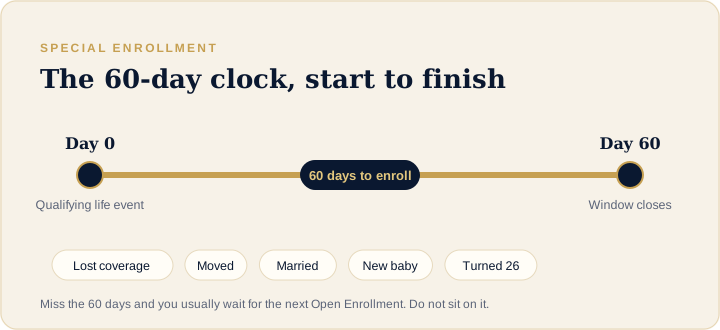
What counts as a qualifying life event?
Common triggers include:
- Losing health coverage, such as leaving a job, aging off a parent's plan at 26, losing Medicaid, or a plan ending.
- Moving to a new ZIP code or county with different plan options.
- Getting married or entering a domestic partnership.
- Having a baby, adopting, or placing a child for foster care.
- Changes in income that affect subsidy eligibility (in some cases).
- Gaining citizenship or lawfully present status.
Each event opens a limited window, usually 60 days, so timing matters. And cost fears are usually overblown. CMS reports that 87 percent of people who picked a marketplace plan for 2026 chose one with a premium tax credit, and the average premium after that credit was $178 a month, down from $619 before it. A mid year plan is often cheaper than people expect. You can check a rough estimate with my subsidy calculator. Miss the window and you may have to wait for the next Open Enrollment.
How the 60 day clock actually works
The details matter here, because the clock does not always start where people think it does.
- Losing coverage lets you shop early. HealthCare.gov lets you qualify if you lost coverage in the past 60 days or expect to lose it in the next 60 days. If you know your job or your plan is ending, you can line up the new plan before the old one stops, so there is no gap.
- A new baby is covered from day one. After a birth, adoption or foster placement, coverage can start the day of the event, even if you enroll up to 60 days afterward.
- The window closes on its own. Nobody sends a reminder on day 59. Put the date on your calendar the day the event happens.
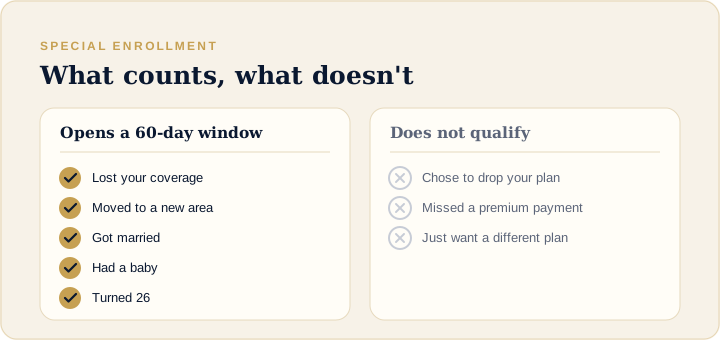
What does not count
This is where I see people get stuck. Choosing to drop coverage you already have does not open a Special Enrollment Period on its own. That includes dropping coverage you have as a dependent, and it includes COBRA. HealthCare.gov is explicit that voluntarily dropping COBRA, or simply stopping your COBRA payments, does not qualify. If you are weighing COBRA against a marketplace plan after a job loss, make that decision inside your first 60 days. My guide to coverage between jobs walks through the comparison.
What if I don't have a qualifying event?
You may still have options. Some private and supplemental plans can be purchased year-round, and it's worth a quick conversation to see what fits until the next Open Enrollment. These plans follow different rules than marketplace plans, and many do not cover pre existing conditions, so read the fine print or have me read it with you.
The next open enrollment is close
If it is already fall, you may not need a special enrollment period at all. Open enrollment for 2027 coverage runs on these dates on HealthCare.gov.
- November 1, 2026Open enrollment begins for 2027 coverage
- December 15, 2026Last day to choose a plan that starts January 1, 2027
- January 15, 2027Open enrollment closes on HealthCare.gov
For 2026, 20 states and Washington, DC ran their own exchanges, and those states can set different deadlines, so check yours if you are not on HealthCare.gov. One more thing for this season: Cigna is leaving the ACA individual market in all 11 states where it sells for 2027, and about 369,000 people will need a new plan. If you get a non renewal letter, here is what it means and what to do.
How to check if you qualify
The fastest way is to talk to a licensed broker. It's free, because brokers are paid by the carriers and the premium is the same either way. Here is exactly how that works. Tell me what changed and I'll confirm whether it opens an SEP and, if so, help you compare plans and enroll before the window closes. If you are self employed, my self employed guide covers how to estimate 1099 income. I'm Carson Hornish, licensed in every state (NPN 21581721).
Common questions
Can I get health insurance if I missed Open Enrollment?
Possibly. A qualifying life event, such as losing coverage, moving, getting married, or having a baby, can open a Special Enrollment Period that lets you enroll outside the normal window. For most events you have 60 days to pick a plan.
What is a qualifying life event for health insurance?
Qualifying life events include losing existing coverage, moving to a new area, getting married, having or adopting a child, certain income changes, and gaining citizenship or lawfully present status. Each opens a limited Special Enrollment Period, usually 60 days long.
Can I enroll before my current coverage ends?
Yes, when you are losing coverage. HealthCare.gov lets you qualify for a Special Enrollment Period if you lost coverage in the past 60 days or expect to lose it in the next 60 days. Enrolling before your old plan ends is the easiest way to avoid a gap.
Does dropping COBRA qualify me for a Special Enrollment Period?
No. HealthCare.gov states that voluntarily dropping COBRA, or choosing to stop paying COBRA premiums, does not qualify you for a Special Enrollment Period. If you want a marketplace plan instead of COBRA, the time to switch is within 60 days of losing your job based coverage or during open enrollment.
What can I do if I have no qualifying life event?
You may still have options. Some private and supplemental plans can be purchased year-round to bridge coverage until the next Open Enrollment, though many do not cover pre existing conditions. A licensed broker can review what fits at no cost.
When is open enrollment for 2027 health insurance?
On HealthCare.gov, open enrollment for 2027 coverage runs from November 1, 2026 through January 15, 2027. Choose a plan by December 15, 2026 for coverage that starts January 1, 2027. States that run their own exchanges can set different deadlines.
Not sure if you qualify?
Tell me what changed and I'll check for a Special Enrollment Period, free, and no pressure.
Get a free quote →Sources
- HealthCare.gov, Special Enrollment Period
- CMS, Exchange coverage remains near record high as 23.1 million enroll for 2026
- CMS, Health Insurance Exchanges 2026 Open Enrollment Report
- STAT, Cigna to exit the ACA individual market in 2027
- CMS enrollment deadlines for 2027 coverage, via healthinsurance.org